Inspiring Book Summary
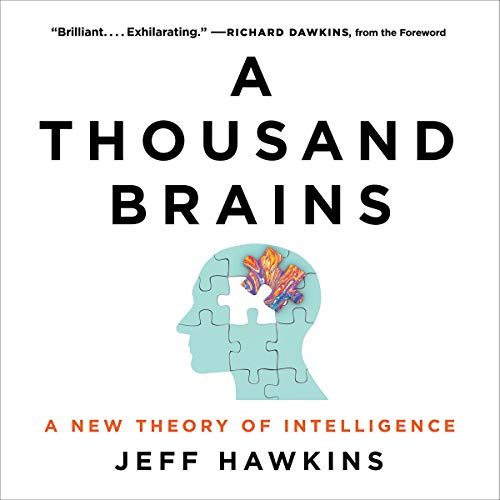
A Thousand Brains
Deep Concepts & Practical Takeaways
Here’s your summary of A Thousand Brains: A New Theory of Intelligence by Jeff Hawkins — vital concepts, implications, and practical insights.
A Thousand Brains – Deep Concepts & Practical Takeaways
1. Multiplicity over Singularity
Instead of one unified model, the cortex operates through thousands of mini-brains—known as cortical columns—each forming its own model of an object or concept. These models “vote” to create a cohesive perception.
Each column is a fully functioning prediction machine, not just a passive data processor.
2. Reference Frames: Grounding Understanding
Each cortical column constructs its own spatial reference frame—capturing both what something is and where it exists in relation to self and environment.
This enables rich sensorimotor understanding: recognizing objects regardless of orientation, touch, or context shifts.
3. Consensus Through Voting
There’s no central overseer in the brain. Instead, understanding emerges through collective agreement—each column offers a prediction, and perception arises from the strongest consensus.
4. Towards a New AI Architecture
Hawkins challenges modern AI’s monolithic neural networks. Instead, he advocates for an architecture that mirrors cortical structure—modular, location-aware, sensorimotor-inclusive.
This biology-aligned approach promises adaptability and efficiency in artificial systems, potentially unlocking AGI pathways.
Why It Matters for You
Core Idea
Application
Distributed Intelligence
Your identity, like the brain, is not unitary — it’s made of many perspectives that must converge for authenticity to emerge.
Contextual Reference
Just as columns build meaning through location-based modelling, you can root your values and insights in contextual rituals, environments, and relational frameworks.
Dialogue Over Self-Judgment
Replace inner conflict with internal voting—invite your inquisitive, playful, and reflective parts to collaborate instead of clash.
Designing Systems, Not Scripts
Instead of trying to “be programming,” create modular habits that adapt fluidly—social rituals, curiosity circuits, embodied practices—inspired by cortical modularity.
Takeaways & Reflective Practices
- Embrace Polyphony in Self-Design
Practice creating environments or rituals where different aspects of you—philosopher, learner, story-weaver, embodied presence—have their own “voice.” - Situate Insight in Space
Anchor your insights not just in thought, but in place—through walking desks, conversation corners, creative nooks—so your body maps your becoming. - Encourage Consensus Over Resistance
When you feel discord—restore connection by asking: Which part of me is speaking now? What truth does it hold? - Architect Adaptive Modules
Instead of rigid daily schedules, design flexible rituals: e.g., “When I sit by the lake, I journal; when I walk in the evening, I listen with presence.”